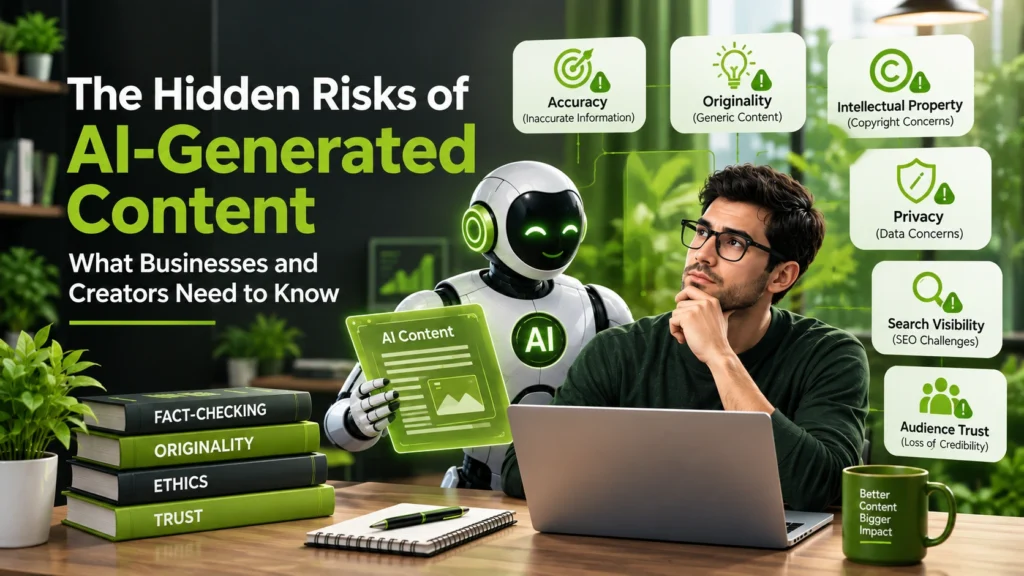
The Hidden Risks of AI-Generated Content: What Businesses and Creators Need to Know
Artificial intelligence has transformed the way people create, publish, and consume digital content. From blog posts and product descriptions to social media updates and marketing campaigns, AI-generated content can help organizations produce material quickly and efficiently. As a result, businesses increasingly use artificial intelligence to support their content strategies and meet growing publishing demands. However, convenience does not eliminate responsibility. The rapid adoption of AI-generated content also introduces several challenges involving accuracy, originality, privacy, search visibility, intellectual property, and audience trust. Therefore, organizations and content creators must understand the risks of AI-generated content before integrating these technologies into their workflows. AI can serve as a valuable creative and productivity tool, but it should not replace human judgment. Instead, businesses should establish clear processes that combine AI capabilities with human expertise, editorial oversight, fact-checking, and ethical standards. When Speed Meets Responsibility One of the primary reasons organizations adopt AI content tools is speed. Traditional content creation can require research, planning, drafting, editing, proofreading, and optimization. AI can accelerate several of these steps, allowing teams to generate initial drafts within minutes. Nevertheless, faster production does not automatically result in better content. AI systems can generate text that appears polished while containing inaccurate statements, missing context, or unsupported claims. Consequently, organizations that prioritize publishing speed over editorial quality may unintentionally distribute misleading information. Human oversight therefore remains essential. Content teams should review AI-generated material before publication and verify important claims against reliable sources. By combining automation with professional review, businesses can benefit from efficiency without sacrificing credibility. The Accuracy Problem: When AI Gets the Facts Wrong One of the most significant risks of AI-generated content involves factual accuracy. AI systems generate responses based on patterns learned from data and the instructions provided to them. They do not automatically guarantee that every statement they produce is correct. Furthermore, AI may sometimes present incorrect information with a confident and professional tone. This can make errors particularly difficult for inexperienced readers to identify. A factual mistake in a casual social media post may cause limited harm, whereas an inaccurate statement in financial, legal, scientific, or technical content can create much more serious consequences. For this reason, businesses should establish fact-checking procedures. Writers and editors should verify statistics, dates, quotations, research findings, product claims, and other important information before publication. Moreover, organizations should avoid treating AI-generated text as an authoritative source simply because it sounds convincing. Originality and the Challenge of Generic Content AI-generated content can also create problems with originality. Because AI systems learn patterns from large quantities of existing material, their output may sometimes resemble common structures, phrases, or ideas already present across the internet. As a result, businesses that rely heavily on automated writing may produce content that feels repetitive or generic. Readers may encounter similar introductions, explanations, expressions, and article structures across multiple websites. Consequently, a website can struggle to establish a distinctive voice. Human creativity provides an important solution. Content teams should use AI to support brainstorming, research organization, outlining, and drafting while adding original experiences, expert perspectives, examples, opinions, and insights. This approach helps organizations create content that offers genuine value rather than simply increasing publication volume. Intellectual Property and Copyright Concerns Another important concern involves intellectual property. Content creators and businesses need to consider whether AI-generated material could reproduce or closely resemble protected material. Although AI-generated content can appear original, organizations should not assume that every output is automatically free from intellectual property concerns. In addition, businesses may use AI to create images, articles, marketing copy, videos, or other materials without fully understanding the terms governing the tools they use. Different AI services may have different rules regarding ownership, commercial use, training data, and content rights. Therefore, companies should review the terms of the AI platforms they use and establish internal policies for AI-generated material. When necessary, legal professionals should provide guidance on complicated intellectual property questions. Taking these precautions can reduce unnecessary legal and commercial risks. Privacy: The Data You Enter Matters AI tools can also create privacy and data security risks when users submit sensitive information. Employees may enter customer details, confidential business information, unpublished documents, internal strategies, or other proprietary material into an AI system without considering where that information goes or how the platform processes it. This issue becomes particularly important for organizations that handle customer or employee data. A company should not assume that an AI platform provides the same level of protection as an internal system or approved enterprise application. Businesses should therefore establish clear rules about what employees can and cannot enter into AI tools. Furthermore, organizations should evaluate data-processing practices, access controls, security measures, retention policies, and contractual terms before adopting AI services. Responsible data handling can significantly reduce privacy-related risks. Bias and the Problem of One-Sided Perspectives AI-generated content can also reflect biases present in the information used to develop AI systems. These biases may influence how a system describes people, industries, cultures, events, or social issues. Moreover, AI may provide incomplete perspectives when a topic contains legitimate disagreement or requires contextual understanding. If organizations publish such content without review, they may unintentionally reinforce stereotypes or present an incomplete picture. Consequently, businesses should review AI-generated material for potential bias and missing perspectives. Human editors can identify problematic assumptions and introduce appropriate context. In addition, organizations should use diverse sources when conducting research and avoid allowing automated systems to make sensitive judgments without meaningful human involvement. The Decline of Human Expertise AI can assist professionals, but excessive dependence on automation can gradually reduce human involvement in the content process. When teams allow AI to perform research, writing, editing, and decision-making without sufficient oversight, employees may spend less time developing their own knowledge and critical-thinking abilities. Over time, this dependence can create a quality problem. Experienced writers and subject-matter experts contribute judgment, context, creativity, and firsthand knowledge that automated systems cannot consistently reproduce. Therefore, organizations should treat AI as an assistant rather than a complete replacement for professional expertise. Human specialists should